
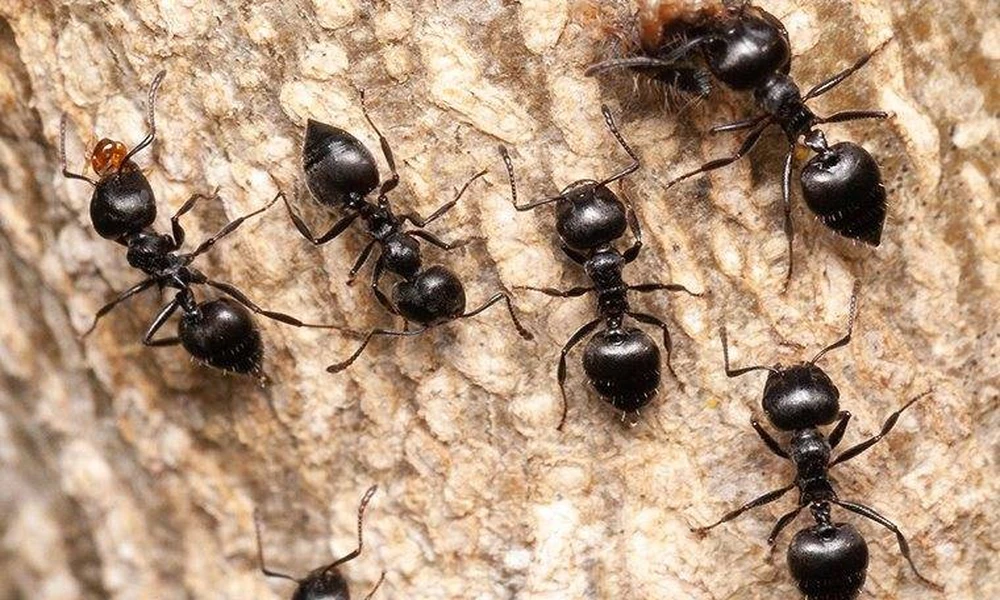
A trail of tiny brown ants crossing your Riverside kitchen counter is a frustrating sight. They might be swept away in the morning, only to return by afternoon. These species are usually Argentine ants, and their extraordinary success in Southern California makes effective ant control for homeowners quite challenging. Understanding how these invaders operate is the first step toward keeping them out for good.
Meet the Argentine Ant
Native to the river basins of South America, the Argentine ant (Linepithema humile) reached the United States more than a century ago and found Southern California’s mild, irrigated landscape suited to its needs. It’s tiny, about an eighth of an inch. It doesn’t sting or bite, and won’t wreck your woodwork. Its menace lies in the overwhelming numbers and an organizational genius that native ants cannot match.
The Supercolony Advantage
Within its native range, competition between neighboring nests keeps populations in check. But in California, researchers have documented that the ants behave as a cooperative supercolony spanning hundreds of miles. Workers and queens move freely between nests without aggression, because the population is so genetically uniform that ants from distant nests treat one another as kin. The implications for a Riverside household include:
- Multiple queens mean a colony has no point of failure.
- Budding lets colonies divide and spread through a neighborhood.
- Cooperation between nests allows the ants to mass enormous foraging forces wherever food or water appears.
In effect, the trail crossing your countertop is a tendril of a network that may extend across your entire community.
Why Riverside Homes Make Ideal Targets
Southern California’s environment plays directly to the Argentine ant’s strengths. During the long, arid periods typical of the Inland Empire, the ants press indoors in search of the moisture their surroundings lack, then linger for the food a kitchen provides. Here are factors that make local homes especially inviting:
- Reliable indoor water from sinks, drains, and pet bowls during dry months.
- Sweet residues and crumbs that fuel their ceaseless foraging.
- Irrigated gardens and mulch beds that offer an ideal nesting ground beside the foundation.
- Aphids and scale insects on ornamental plants, which the ants “farm” for sugary honeydew.
Once a scout discovers a resource, it lays a chemical trail that summons legions of followers within hours.
Recognizing an Invasion
Argentine ants rarely arrive quietly. Telltale signs include:
- Persistent trails along baseboards, windowsills, and counters, often issuing from a crack or gap.
- Concentrated activity around kitchens, bathrooms, and any source of water.
- Nests tucked beneath sidewalks, potted plants, landscape timbers, or mulch close to the house.
Why Store-Bought Sprays Often Backfire
Spraying a visible trail with an over-the-counter product kills the foragers you can see, but this will not affect the queens and the rest of the colony. Worse, the chemical disturbance can prompt the colony to fragment and relocate, producing several new nests where there had been one. Because Argentine ants function as a unified colony, a fragmented approach seldom produces lasting results. Durable results demand strategic baiting and an integrated approach that targets the colony at its source.
A Local Specialist Worth Knowing
Dealing with something this organized calls for local expertise. This is the kind of local expertise Akela Pest Control brings to Riverside, Fontana, and Corona. With over a decade of hands-on experience in the region, the company is admired for its knowledgeable technicians and its dedication to eco-friendly, family- and pet-safe methods. Rather than chasing trails with blunt instruments, its team applies Integrated Pest Management to locate nests, place targeted baits, and correct the conditions that invite ants indoors.
Outlasting a Persistent Invader
Argentine ants flourish in Southern California because they cooperate, adapt, and multiply faster than casual countermeasures can manage. For Riverside homeowners, the lesson is that lasting relief comes not from reacting to each new trail, but from a colony-focused strategy carried out by professionals who understand the species.